


Introduction
What happens when your ideal customers don't even know they need you yet? There's no search volume for your product, no BOFU keywords to target, and no established playbook to follow. Most agencies would walk away. We built an entirely new one.
This is the story of how we helped PayerPrice grow from 10 daily clicks to 280,000 organic clicks in 12 months. By combining a proprietary programmatic SEO framework with a full content engine, we turned PayerPrice's data asset into a sustainable inbound acquisition channel that drove $400,000 in new business.
Our work with PayerPrice took the best content-led SEO content engine foundation that combines keyword research, topic clusters, and consistent content production, and layered a custom programmatic layer on top, purpose-built for a market that didn't yet exist.
The Challenge
PayerPrice, a B2B healthcare data platform offering payer contracting benchmarking intelligence to hospitals, providers, and multi-specialty physician groups, wanted to build a scalable inbound engine from scratch. When PayerPrice came to Voluminous, their online presence was nearly invisible; Google Search Console showed just 10 daily clicks and 50 daily impressions.
But the bigger problem wasn't the numbers. It was the category. The market didn't know this kind of data existed. Nobody was searching for what PayerPrice sold. Adjacent search results were completely different products. There were no BOFU keywords to chase, no established competitors to reverse-engineer, and no proven playbook to follow.
A typical SEO strategy wouldn't work here. They didn't need to capture demand. They needed to create it. What they needed was a strategic partner who could build an inbound engine from the ground up, one designed to generate awareness, engage visitors, and convert them into activated users.
Voluminous's Solution
We started with a fundamental question: if no one is searching for your product, what are they searching for, and how do we bridge that gap?
The answer was to flip the funnel entirely. Rather than starting with conversion-focused content, we designed a framework built around the data PayerPrice already had.
#1: Awareness via Answer-First Programmatic SEO
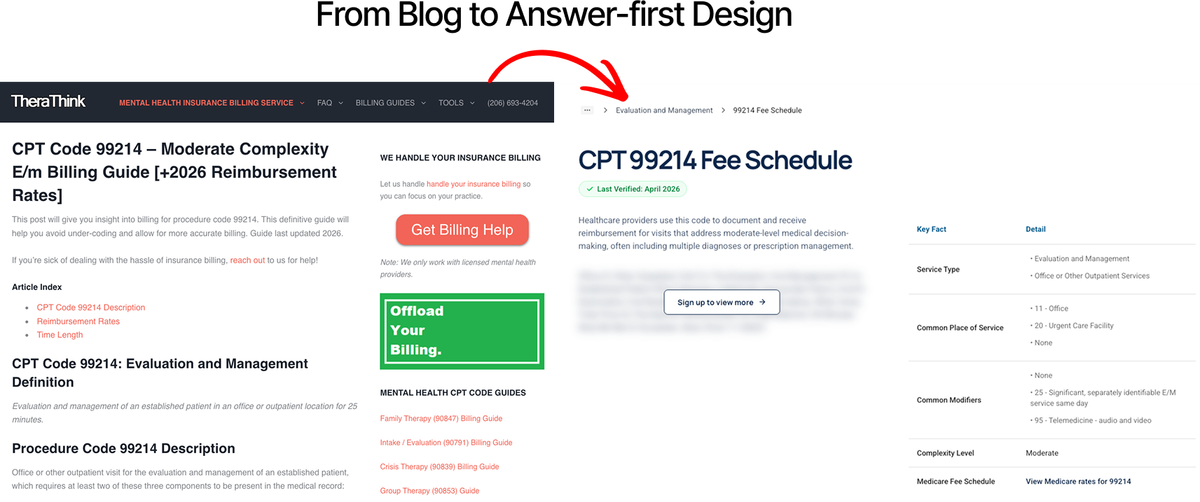
After a deep SERP analysis, we spotted two clear opportunities: every ranking result was a blog post requiring users to read through entire articles to find a single data point, and the TOFU queries could be generalized into repeatable patterns.
We designed what we call the "answer-first" template: pages that surface the most important information immediately, above the fold. Then we generated thousands of programmatic SEO pages targeting these TOFU queries at scale. PayerPrice became the only source in the SERP that answered the question before asking anything in return.
#2: Convert via Interactive Widget
In each programmatic SEO page, we embedded an interactive widget that let visitors explore data dimensions directly on the page, no sign-up required. The widget delivered enough immediate value to create a natural urge to go deeper. When visitors signed up, they unlocked additional data dimensions to query. TOFU traffic became product signups in a single session.
#3: Scaling with a Standard SEO Content Engine
With the programmatic SEO foundation in place and performing, we turned our attention to building a sustainable content engine around PayerPrice's core audience. We kicked things off with our tried-and-tested discovery phase: a deep dive into PayerPrice's online presence and competitive landscape, uncovering hidden opportunities and creating a tailored roadmap.
Here's how we built it:
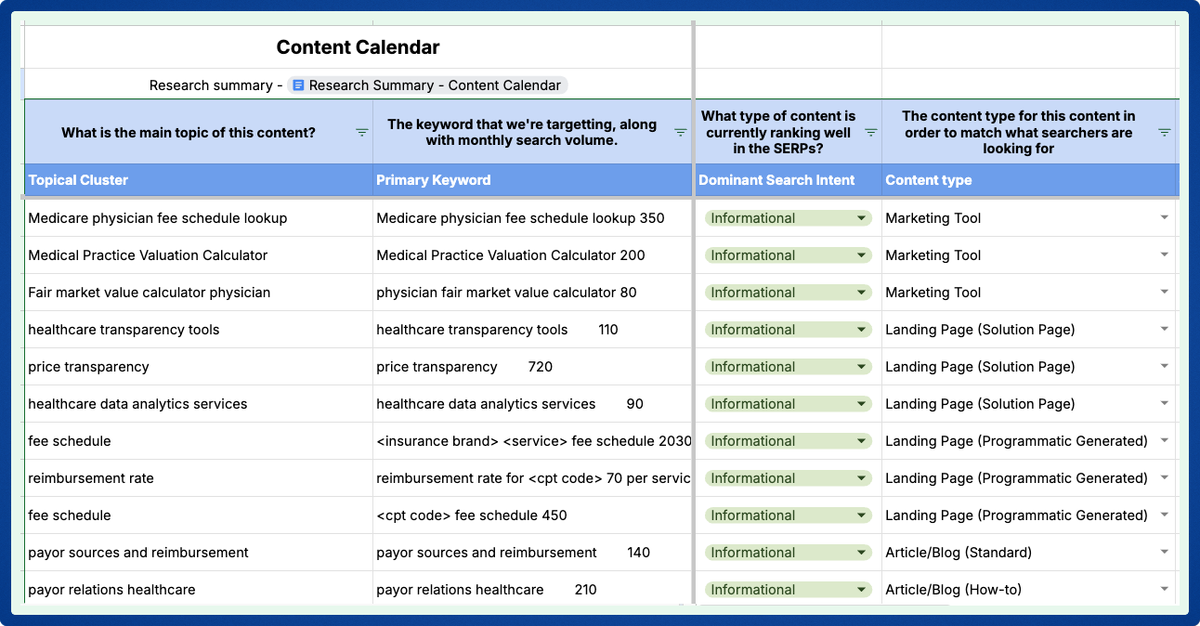
#3.1: Deep Audience & Topic Research
We identified the highest-value keyword opportunities across every stage of the buyer journey, mapping them to PayerPrice's ideal customer profile and revenue goals.
#3.2: Building Topic Clusters
To establish PayerPrice as an authority in their space, we organized content into topic clusters with pillar pages and supporting articles. This allowed us to rank for a broad range of essential keywords while capturing niche queries that brought in qualified traffic.
#3.3: Content Calendar & Production Schedule
We built a content calendar that ensured a steady publishing schedule, aligning content production with PayerPrice's marketing objectives. Consistency was key to seeing steady, compounding growth in both traffic and engagement.
#3.4: High-Quality, SEO-Optimized Content
We produced SEO-optimized content: from TOFU blog posts to in-depth BOFU guides, each piece tailored to PayerPrice's audience. These articles addressed their prospects' pain points, guided them through the buyer's journey, and were strategically crafted to rank for high-value keywords.
The Results
The numbers speak for themselves. In just 12 months, PayerPrice went from near-zero organic presence to a dominant position in their category:
- •+174x Traffic Growth: From 1,700 to 280,000 monthly clicks from Google.
- •+280,000 Organic Clicks: A massive new acquisition channel built entirely from scratch.
- •+30 Domain Rating: A significant authority gain in a competitive vertical.
- •+7,294 Keywords Ranked in Top 5: Broad keyword coverage across thousands of high-intent queries.
- •+$400,000 in New Business: Organic search became a direct pipeline driver.
We've also built an algorithm-proof strategy that held through the August 2025 Spam Update and the December 2025 Core Update, proof that bulletproof programmatic SEO outlasts scaled content abuse.
What This Proves
The most common objection we hear from B2B companies in emerging or undefined categories is: "We've tried SEO before and it didn't work." More often than not, the problem wasn't SEO. It was the strategy.
A generic blog-and-backlink approach assumes demand already exists. When it doesn't, you need to build it. PayerPrice's results show what's possible when you design your SEO program around the asset you already have, engineer the user experience to convert awareness into action, and back it with the content fundamentals that compound over time.
We've seen this principle work time and time again. When you identify the right audience, map the content to their journey, and execute with consistency, you can build an inbound engine that captures that demand.
When your product sits in a category that buyers don't know to search for yet, the opportunity is bigger than it looks. The traffic is there. The buyers are there. They just aren't searching for you by** **name. Yet.
If you're ready to build an inbound engine that captures that demand, book a discovery call with Voluminous.

